
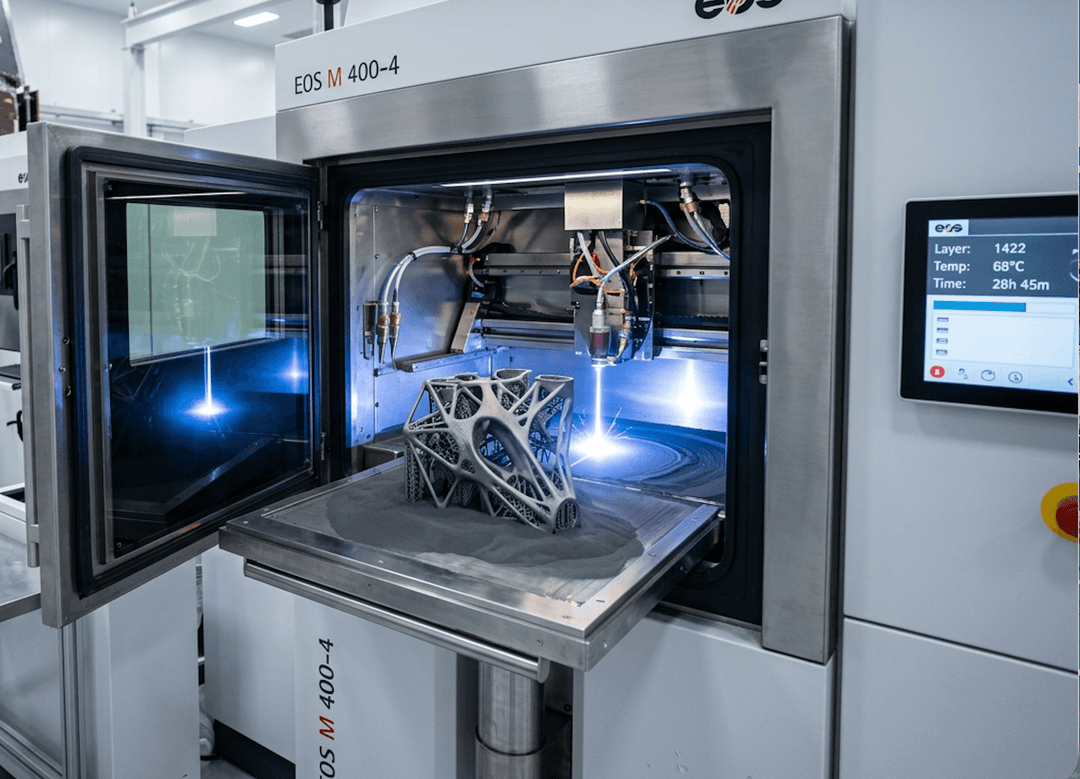
Why Aerospace Manufacturers Are Investing in Additive Manufacturing
The aerospace industry has always been driven by innovation. From improving fuel efficiency to reducing aircraft weight and accelerating production, manufacturers are constantly looking for ways to build better components while maintaining the highest standards of quality and performance.
One technology leading this transformation is additive manufacturing. Once primarily used for prototyping, industrial 3D printing has evolved into a reliable production method for high-performance aerospace components. At Terrestrial X, we’re helping manufacturers leverage advanced additive manufacturing technologies to streamline production, reduce costs, and solve complex engineering challenges.
What Is Additive Manufacturing?
Additive manufacturing is the process of creating parts layer by layer using digital design files. Unlike traditional manufacturing methods that remove material through cutting or machining, additive manufacturing builds components only where material is needed.
This approach allows engineers to produce highly complex parts that would be difficult—or even impossible—to manufacture using conventional methods.
For the aerospace industry, where precision, weight, and performance are critical, the advantages are significant.
Lightweight Components Improve Performance
Every kilogram removed from an aircraft can contribute to improved fuel efficiency, increased payload capacity, and lower operating costs.
Additive manufacturing allows engineers to optimize component designs by reducing unnecessary material while maintaining structural strength. Complex internal geometries, lattice structures, and lightweight designs can be manufactured without compromising performance.
These design capabilities help aerospace manufacturers produce parts that are both lighter and stronger than many traditionally manufactured alternatives.
Faster Prototyping and Product Development
Developing aerospace components often involves multiple rounds of design revisions and testing.
Traditional manufacturing methods can require specialized tooling and long lead times for each design iteration. Additive manufacturing significantly shortens this process by allowing engineers to produce functional prototypes quickly and make design adjustments without investing in new tooling.
The result is a faster development cycle that helps bring new products to market more efficiently.
Reduce Material Waste
Many aerospace components are manufactured from high-value materials where waste can become a significant expense.
Because additive manufacturing builds parts layer by layer, it uses only the material required for the final component. Compared to traditional subtractive manufacturing processes, this can significantly reduce material waste while improving overall production efficiency.
For organizations focused on both cost savings and sustainability, this is an important advantage.
Manufacture Complex Parts with Greater Design Freedom
Traditional manufacturing methods often place limitations on part geometry. Engineers may need to simplify designs to accommodate machining or assembly requirements.
Additive manufacturing removes many of these constraints.
Designers can create intricate internal channels, lightweight lattice structures, and highly customized geometries that improve performance while reducing the number of individual parts required in an assembly.
Consolidating multiple components into a single printed part can also reduce assembly time and minimize potential points of failure.
Improve Supply Chain Resilience
Recent global supply chain disruptions have highlighted the importance of manufacturing flexibility.
Additive manufacturing enables companies to produce parts closer to where they’re needed, reducing dependence on lengthy supply chains and specialized tooling. Digital inventories also make it possible to manufacture replacement components on demand rather than maintaining large inventories of physical parts.
For aerospace organizations, this flexibility can improve responsiveness while reducing storage and inventory costs.
Supporting Low-Volume, High-Value Production
Unlike industries that produce millions of identical components, aerospace manufacturing often involves lower production volumes with highly specialized parts.
This makes additive manufacturing particularly well suited for the industry.
Without the need for expensive tooling or moulds, manufacturers can economically produce small production runs, replacement parts, and customized components while maintaining exceptional quality standards.
Why Work with Terrestrial X?
At Terrestrial X, we combine advanced manufacturing technologies with engineering expertise to help organizations solve complex production challenges.
Our team works with customers throughout every stage of the manufacturing process—from design optimization and prototyping to production and quality assurance. Whether you’re developing new aerospace components or looking to improve existing manufacturing processes, we provide innovative solutions that support performance, efficiency, and long-term success.
By leveraging the latest advancements in additive manufacturing, we help our customers reduce lead times, improve production flexibility, and manufacture high-quality components with confidence.
The Future of Aerospace Manufacturing
As aerospace technology continues to evolve, manufacturers are looking for smarter ways to design and produce the components that power the next generation of aircraft and aerospace systems.
Additive manufacturing is no longer an emerging technology—it’s becoming an essential part of modern aerospace production. From lightweight designs and rapid prototyping to improved supply chain resilience and greater manufacturing flexibility, the benefits are reshaping how the industry approaches engineering and production.
If your organization is exploring advanced manufacturing solutions, Terrestrial X is ready to help. Contact our team to learn how our additive manufacturing expertise can support your next aerospace project and help you stay ahead in an increasingly competitive industry.